

Last Updated: November 22, 2026
Quick Summary
To choose an acting school, first define your goals and current experience level, then match the program to them. Compare formats, curriculum, on-camera focus, instructor credentials, class size, and total cost before enrolling. Verify claims and get refund terms in writing.
- Match the program to where you are now, not where you hope to be in five years.
- Ask whether the curriculum teaches on-camera technique directly if you plan to work on screen.
- Verify instructors’ professional credits through an independent source such as IMDb.
- Compare schools by total cost and cost per instructional hour, not headline tuition alone.
- Be wary of schools that guarantee roles, pressure same-day enrollment, or won’t put refund policies in writing.
Table of Contents
- Start With Your Acting Goals and Experience Level
- Compare Program Types: Studio Classes, Conservatories, and Degree Programs
- Evaluate the Curriculum, Teaching Methods, and On-Camera Focus
- Check Instructor Credentials, Faculty Track Record, and Class Size
- Understand Audition Preparation, Admissions, and Application Timelines
- Compare Tuition, Fees, and Total Cost Before You Enroll
- Red Flags to Watch For and Your Next Step in Choosing a School
- Frequently Asked Questions
Start With Your Acting Goals and Experience Level
Choosing an acting school starts with an honest answer to two questions: what do you want to do with acting, and where are you right now? The right acting school depends on both. A school that suits a retiree doing community theater is a poor fit for a working actor preparing for network auditions. Before you compare a single tuition page, write down your goals and your current level of training.
Matching Training to Beginners, Adults, and Working Actors
Beginners usually need structure more than intensity. Parents weighing training for a child can check what to look for in professional acting training for kids before enrolling.
Adults often bring years of life experience but little formal technique, and some have already performed in community or regional theater. Look for classes that treat adult students as serious learners and address the specific gap between stage work and on-camera work.
Working actors need something different: targeted scene study, audition preparation, and feedback on specific material. Ask whether advanced classes exist, how small they are, and whether the instructors work in the industry now.
Our recommendation is simple. Match the program to where you are, not where you hope to be in five years. You can always move up.
Compare Program Types: Studio Classes, Conservatories, and Degree Programs
Acting training comes in several formats, and each one fits a different budget, schedule, and career path. Studio classes are generally the most flexible option. Conservatories and university degree programs typically involve longer, more intensive training and often an academic credential.
Short studio courses are a practical way to test your commitment before spending more. A six-week class, for example, lets you see how you respond to the work, the instructor, and the pace. A New Thursday 6 Week Class for exactly that kind of trial, and our New On Camera Teen Class On Tuesday Nights shows the kind of recurring format available for younger students.
Conservatories and degree programs suit people who want immersive, multi-year training and are prepared to commit the time and money. They are not required for a successful screen career, but they can offer structured performance opportunities and peer networks that a weekly class does not.
Online, In-Person, and Hybrid Trade-Offs
Online classes remove travel and make it easier to train across time zones. The trade-off is limited physical feedback, less ensemble energy, and fewer chances to rehearse with partners in person. In-person classes provide that immediate interaction. Hybrid programs combine both, and they can work well if you want the convenience of online theory with the hands-on work of a live room.
Evaluate the Curriculum, Teaching Methods, and On-Camera Focus
A school’s curriculum tells you what you will actually practice. Read the course descriptions closely and look for specifics: scene study, script analysis, improvisation, voice, movement, and audition technique. Vague promises about “developing your craft” do not tell you much.
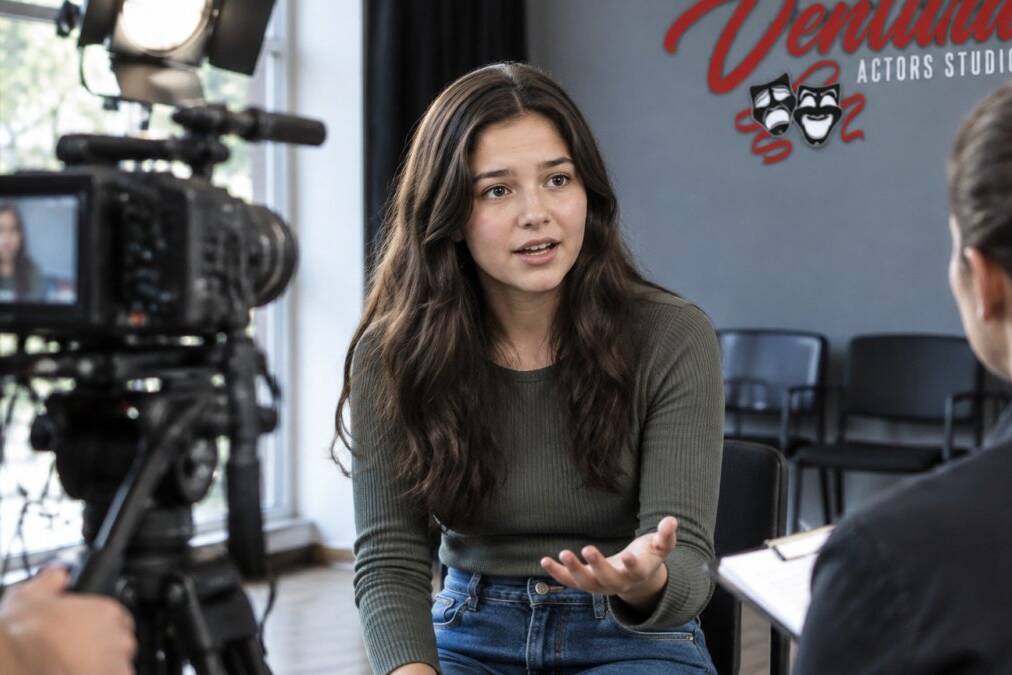
If you intend to work on camera, confirm that the school teaches on-camera technique directly. Stage projection, eye lines, hitting marks, and adjusting performance for a close-up are different skills. Ask whether students shoot scenes and review the footage, and whether the feedback is specific.
Teaching methods matter as much as content. Ask how a typical class is structured, how the instructor gives notes, and whether students perform for each other regularly. A school that spends most of its time lecturing will train you differently from one that puts you on your feet from the first session.
Check Instructor Credentials, Faculty Track Record, and Class Size
Instructors do the teaching, so their backgrounds deserve scrutiny. Look for teachers who have worked professionally in the mediums you care about and can explain how they apply that experience in class. Verify claims directly: check the instructors’ published credits, ask for a biography, and confirm that their work can be found through an independent source such as IMDb or a casting database.

Ask about the school’s track record too. Students who have booked roles, and the kinds of productions they booked, are useful signals of a school’s results. Be cautious of any school that cannot name specific outcomes or refuses to discuss its faculty.
Class size shapes how much attention you get. A class of eight gives you far more feedback per session than a class of thirty. Ask how many students are enrolled, how many instructors are present, and how often you will perform individually.
Understand Audition Preparation, Admissions, and Application Timelines
Audition skills are a separate discipline from scene work, and many students freeze in auditions because they were never trained for them. Ask a school exactly what its audition preparation involves: cold reads, slate training, sides work, and mock auditions with feedback are good signs.
Admissions requirements vary. Some programs require an audition or interview, others ask for a headshot, resume, or short written statement, and some are open enrollment. Check deadlines well in advance, especially for conservatories and degree programs, which often admit students only once or twice a year. Build the application timeline into your planning rather than discovering it after the window has closed.
Compare Tuition, Fees, and Total Cost Before You Enroll
Most school pages show a headline tuition number and little else.
Start by asking each school for a written breakdown that separates the following:
- Tuition or course fee, the base price for the class or term.
- Deposit and payment schedule, how much is due up front, whether installments are available, and whether a payment plan carries a fee.
- Registration or enrollment fee, a one-time charge that is easy to overlook.
- Materials and supplies, scripts, headshots, rehearsal props, recording equipment, or software.
- Showcase, performance, or production fees, many programs charge separately for a final showcase, and some require you to sell tickets.
- Private coaching or extra classes, confirm whether these are included or billed per session.
- Travel, parking, and housing, for degree programs, add room and board and the income you forgo if you study full time.
Once you have those numbers, normalize them. Divide total cost by the number of instructional hours to get a cost-per-hour figure, then compare that figure across programs.
Refund and cancellation policies deserve the same scrutiny as price. Ask any school in writing what happens if you withdraw before or after the first class, whether a deposit is refundable, and whether a deadline applies.
Watch out: a low tuition figure can hide a showcase fee, a materials charge, or a private-coaching package that raises the real cost.
Finally, treat any quoted price as time-sensitive. Rates change by term, and a figure you saw last season may not apply. Request current pricing directly from each school and ask what the price includes before you compare.
Headline tuition rarely reflects what you will actually pay, so compare the total cost of each program side by side.
| Cost item | What to ask | Why it matters |
|---|---|---|
| Tuition or course fee | Base price for the class or term | Starting point for comparison |
| Deposit and payment schedule | Amount due up front and whether installments are offered | Affects cash flow and any plan fees |
| Registration or enrollment fee | One-time charge | Easy to overlook |
| Materials and supplies | Scripts, headshots, props, equipment | Adds cost beyond tuition |
| Showcase or production fees | Separate charges for a final showcase | Can be a significant extra expense |
| Private coaching or extra classes | Included or billed per session | Can raise the real cost |
| Travel, parking, and housing | Costs for in-person or full-time study | Major factor for degree programs |
| Cost per instructional hour | Total cost divided by hands-on hours | Allows fair comparison across programs |
Red Flags to Watch For and Your Next Step in Choosing a School
Warning signs are easier to spot when you know what a healthy program looks like. To narrow your options, see the regional comparison of acting classes in Southern California.
To compare your shortlist fairly, use a simple scorecard. Rate each school from 1 to 5 on the criteria below, then weight the rows that matter most to your goals. This turns a pile of impressions into a side-by-side comparison you can defend.
- Curriculum fit, Does the course cover the skills you need (scene study, audition technique, on-camera work) at your level?
- Faculty credentials, Can you verify instructors’ professional credits through an independent source?
- Class size and stage time, How many students per instructor, and how often will you perform individually?
- Total cost, What is the all-in figure, and what is the cost per instructional hour?
- Outcomes, Can the school name specific student bookings or placements rather than general claims?
- Admissions and timeline, Do the audition requirements and deadlines fit your schedule?
- Format fit, Does online, in-person, or hybrid delivery match how you learn best?
- Refund and contract terms, Are the policies clear and in writing?
Score each school before you decide, and revisit the scores after you visit. A program that scores well on paper but feels wrong in the room is worth downgrading.
Your next step is to shortlist two or three schools that fit your goals and experience level, then ask to observe a class or sit in on a session. Meeting instructors and watching how they give notes will tell you more than any brochure. Compare the answers you get against your scorecard, and ask each school the same questions so the comparison stays fair.
Get started with Ventura Actors Studio and build the on-camera skills, audition confidence, and scene study that TV, film, and commercial work demands.
Frequently Asked Questions
Is 14 too late to start acting?
No. Many teenagers begin formal acting training at 14 and go on to book professional work. What matters more is consistent practice and a class that fits their level. Mixed-level classes can help beginners build fundamentals alongside more experienced students. Ask a prospective school whether it accepts students at your age and whether it offers age-appropriate material. A good school will explain how it teaches absolute beginners and what progress looks like in the first few months.
Do most successful actors go to acting school?
Many working actors have formal training, but it is not required for every career path. Some actors build their skills through workshops, community theater, or on-set experience. When you evaluate a school, focus on whether its training addresses the work you want, such as on-camera acting, scene study, or audition preparation, rather than assuming a credential alone will lead to roles. Ask about alumni outcomes and how the school tracks them.
How do I know if an acting school is right for me?
Start by defining your goals: stage work, television, film, commercials, or general confidence building. Then compare each school’s curriculum, class size, and instructor backgrounds against those goals. Attend a trial class or observation session if one is offered. Notice whether the teaching style challenges you without making you feel unsafe, and whether instructors give specific, actionable feedback. A school that fits your goals and learning style is usually the right choice.
How much does acting school cost?
Costs vary widely depending on the program type, length, and format. Pricing depends on the course schedule, class format, and any additional fees, so ask each school for a current tuition schedule and a full breakdown of costs. Check whether registration fees, materials, audition fees, or performance costs are included. For current prices and enrollment options, contact Ventura Actors Studio directly through its website for a quote.
Should I choose an acting school or a college theater program?
The answer depends on your timeline, budget, and career goals. A degree program provides structured, long-term study and general education, while a private acting studio often offers focused, flexible training on specific skills like on-camera work or audition technique. Compare the time commitment, total cost, and the practical experience each option provides. Many actors combine focused studio training with other education rather than choosing only one path.


Related Posts
How to Get Into TV Acting: A Step-by-Step Guide
Learn how to get into TV acting, from training and classes to headshots, demo…


How to Prepare for Professional Film Auditions
Prepare for film auditions with a step-by-step process covering self-tapes,…

The Beginner’s Guide to Acting for TV and Film
Acting for TV and film beginners: learn on-camera technique, choose the right…