

Quick Summary
Acting for TV and film differs from stage work mainly in scale and precision. The camera captures small, truthful reactions up close, so beginners should practice stillness, listening, hitting marks and consistent takes. Start by recording short scenes on your phone each week.
- Learn your lines well enough to listen to your scene partner rather than waiting for your cue.
- Match the size of your behavior to the shot: reduce physical business in close-ups.
- Look at your scene partner’s eyes, not the lens, unless the director asks otherwise.
- Record a short scene weekly and watch it back with the sound off.
- Check any audition listing against established casting platforms before paying anything or sharing personal information.
Table of Contents
- Acting for TV and Film Beginners: Where to Start
- Screen Acting vs. Theater for Beginners: What Actually Changes
- Choosing the Right Training: Classes, Coaching, and Degree Programs Compared
- On-Camera Technique: Acting Tips for Beginners
- Working with Acting Scripts for Beginners: Scene Study and Character Work
- Self-Tapes, Auditions, and Finding Legitimate Opportunities
- Taking Your First Step: Enrolling in Your First On-Camera Class
- Frequently Asked Questions
Acting for TV and film beginners starts with a simple question: how is performing for a camera different from performing on stage? The difference is more practical than most beginners expect. The stage rewards projection and a full-body performance.
If you are new to this, you are not behind. Many working on-camera actors began with little formal training.
Acting for TV and Film Beginners: Where to Start
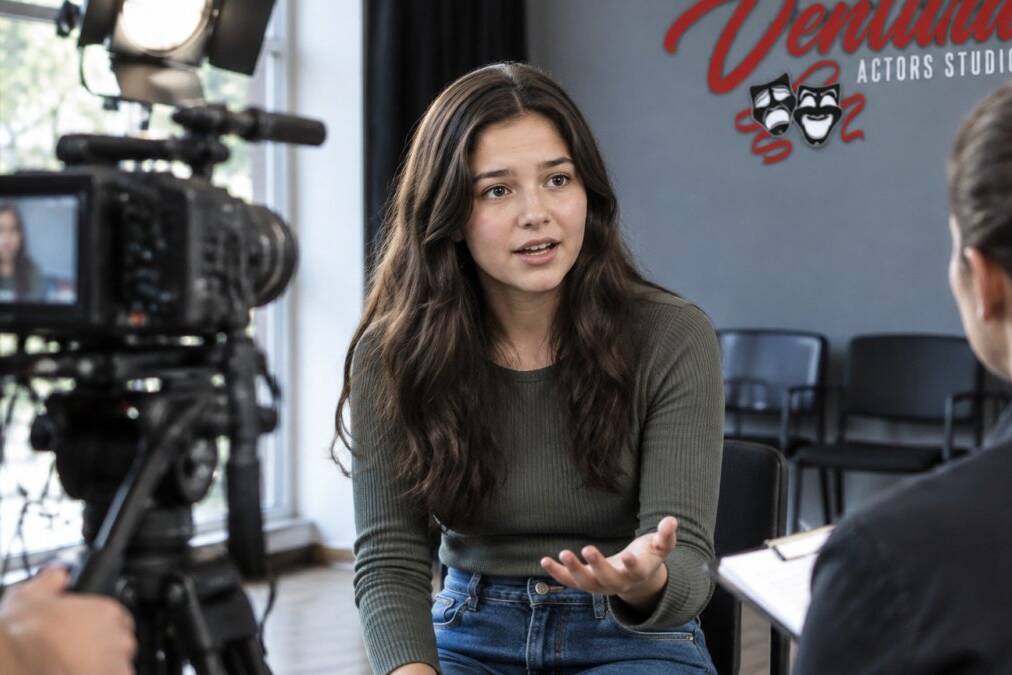
Start by watching and then doing. Watch television and film scenes with the sound off, and notice where the actor’s face does most of the work. Then record yourself reading a short two-person scene on your phone and watch it back.
Build three habits early:
- Learn your lines to the point of freedom. You should know the scene well enough to listen to your scene partner, not wait for your cue.
- Stay in the moment. Camera work rewards responding to what is happening, not performing what you planned.
- Get a camera on yourself every week. Repetition in front of a lens is the fastest way to lose self-consciousness.
A common mistake is buying expensive gear before building these habits.
Screen Acting vs. Theater for Beginners: What Actually Changes
The biggest change is scale. On stage, an audience sees your whole body from a distance, so gestures and voice must carry. On camera, the lens can capture a flicker of thought from a few inches away.
Other differences matter just as much:
- Takes are short and repeated. You may perform the same moment several times, so consistency matters more than one big peak.
- Hitting marks matters. Stepping outside a frame or losing focus can ruin a shot.
- Continuity matters. Your hand position and emotional level must match across takes.
Theater trains endurance and vocal range. Screen acting trains economy and listening. Many strong screen actors come from theater, but they had to unlearn the habit of projecting.
Choosing the Right Training: Classes, Coaching, and Degree Programs Compared
There is no single correct path. Your budget, schedule and goals determine which format fits.
Comparison of Training Formats
| Format | Typical Commitment | Best For | Main Drawback |
|---|---|---|---|
| Group classes | Weekly sessions over several weeks | Beginners building fundamentals | Less individual feedback |
| Private coaching | Scheduled one-on-one sessions | Audition prep and specific goals | Higher per-hour cost |
| Degree programs | Multi-year, full-time study | Students planning a long-term career | Significant time and tuition |
| Workshops | Short, intensive sessions | Sampling a technique or refreshing skills | Limited depth |
Mixed-level group classes suit most beginners because they offer structure and a low-pressure place to practice on camera. Private coaching becomes valuable once you are auditioning and need targeted notes on specific material.
Costs, Budgeting, and Evaluating a Program
Pricing varies by format, length and instructor experience, so compare programs using the same criteria rather than tuition alone. Ask how many students share a class, how much time each student gets on camera, and whether instructors have current industry experience. for current tuition and enrollment options, contact us directly for a quote.
A useful test: if a program cannot tell you how students practice on camera or what they do after class, keep looking.
On-Camera Technique: Acting Tips for Beginners
On-camera technique is mostly about restraint and precision. Your face can show a great deal at close range, so decide what the character is thinking before you decide what the face should do. The practical skills below are what separate beginners who look “stagey” on screen from those who read as natural.

Know your shot size before you act
Ask the first assistant director or whoever is running the camera what the shot is before you roll. Shot size changes everything:
- Wide shot: The camera sees your whole body and the space around you. Gestures and spatial blocking matter; facial nuance will not read.
- Medium shot: Roughly waist up. This is where most dialogue scenes live. Keep gestures small and below the frame line unless the script calls for more.
- Close-up: Head and shoulders. The camera captures a flicker of thought. Blinking, jaw tension and eye movement all read, so reduce physical business and let the thought do the work.
A common beginner mistake is performing a close-up with the same energy as a medium shot. Match the size of your behavior to the size of the frame.
Eyelines: where to look and why it matters
On a film set, you almost never look at the lens. Look at your scene partner’s eyes, or at the mark the camera operator gives you if the partner is off-camera.
Watch out: drifting eyelines are one of the most common reasons a beginner’s take is unusable, because the editor cannot cut around a look that wanders off the partner’s face.
Hitting marks and working with the camera crew
A mark is a piece of tape on the floor showing where you should stand so the camera keeps you in frame and in focus.
Most practitioners find that the simplest approach is to walk your path once during rehearsal, note where your feet land, and then repeat that path on every take.
Continuity: matching across takes
Film is shot out of order and in pieces, so continuity is part of the job. Keep track of:
- Hand and arm positions, if you pick up a cup with your right hand in take one, do it again in take two.
- Emotional level, if the scene starts at a seven, do not start take two at a three.
- Costume and props, leave them where the continuity supervisor or script supervisor expects.
A script supervisor will usually track these details, but beginners who track their own continuity get called back more often.
Performing for close-ups
In a close-up, the camera is close enough to see you think. Try these exercises:
- Read a scene silently, then speak it. Let the thought come first; the face follows.
- Hold a moment after the line. Film editors often cut on reactions, so the listening after a line matters as much as the line.
- Reduce physical business. In a close-up, a small swallow or a shift in the eyes can carry more than a gesture.
- Practice with a phone at chest height. Record a short scene, then watch it back with the sound off to see what your face is doing.
Watch out: beginners often push emotion harder when a take feels flat. On camera, the usual fix is to slow down and think more, not to act bigger.
Listening and reacting on camera
Screen acting rewards reacting to what is actually happening in the scene, not performing what you planned in rehearsal. Stay available to your partner, and let the take be slightly different each time. Consistency matters, but so does freshness, the editor needs usable options, not identical copies.
Working with Acting Scripts for Beginners: Scene Study and Character Work
Scene study is where screen acting is built. Read the whole script first, then the scene, and ask three questions: What does my character want in this scene? What is standing in the way?
Mark the script with action verbs such as “persuade,” “reassure” or “accuse.” These give you playable choices. Then rehearse the scene with a partner and change one choice at a time to see how the scene shifts.
Self-Tapes, Auditions, and Finding Legitimate Opportunities
Many auditions now begin as self-tapes, which means recording yourself reading for a casting team and submitting the video. A clean, well-lit, well-framed self-tape can move a beginner forward even with limited credits; a poorly shot one can sink a good read. The practical checklist below is what most beginners wish they had on day one.
Self-tape setup: framing, sound, light and background
- Framing: For a standard self-tape, frame yourself from the chest up, with your eyes roughly one-third of the way down from the top of the frame. Leave a little headroom. If the casting notice specifies a different frame, follow it.
- Camera height: Put the phone or camera at about eye level. A stack of books works. Shooting up your nose or down at the floor reads as amateur.
- Light: Face a window or a lamp so the light falls evenly on your face. Avoid a bright window behind you, which turns you into a silhouette.
A smartphone on a tripod is enough to start. Do not buy gear before you have booked a few self-tapes and know what your setup is missing.
Recording and submitting a self-tape
- Read the casting notice twice. Note the deadline, the file format, the naming convention and whether they want a slate.
- Do a test recording to check frame, light and sound before you perform the scene.
- Record several takes, then watch them back and pick the one where you are listening and reacting, not the one with the biggest emotional peak.
- Name the file as instructed. If no instruction is given, use your name and the role.
- Upload to the platform the notice specifies and confirm the file plays before the deadline.
Watch out: submitting a self-tape recorded in portrait orientation when the notice asks for landscape (or the reverse) is a common reason a beginner’s tape is passed over before it is watched.
Audition preparation and experience
For in-person auditions, arrive early, sign in, and bring a headshot and resume if you have them. Learn the sides (the pages you were sent) well enough to look up at your reader.
A first audition is a learning experience, not a verdict. Most working actors audition many times for every booking, and beginners should expect the same ratio.
Finding legitimate auditions and avoiding scams
Be cautious about opportunities. Legitimate casting calls generally do not charge actors to audition. Common warning signs include:
- A request for payment to “secure” an audition or a role.
- Pressure to pay for expensive photos or training from a single company before you can be submitted.
- A “casting director” who will not say which project or production company they represent.
Check any listing against established casting platforms and union guidance before you share personal information or pay for anything.
Building beginner materials: headshots, resumes and representation
You do not need professional materials on day one, but you will need them once you start auditioning regularly. A simple, well-lit headshot that looks like you on a normal day is more useful than an expensive, heavily retouched photo. A one-page resume listing training, any credits, and special skills is enough to start.
Taking Your First Step: Enrolling in Your First On-Camera Class
Your first step is smaller than it feels. Choose a beginner-friendly class, commit to a single term, and plan to record yourself every week. Progress on camera usually shows up over months of repetition rather than in a single class.
At Ventura Actors Studio, our mixed-level classes welcome beginners and give them structured, on-camera practice from the start.
Frequently Asked Questions
How do you get started in TV acting?
Start with a structured, on-camera training program so you learn to act for a lens rather than a stage. Build a basic headshot and resume, practice short scenes on video, and watch your recordings critically. Once you have material, begin submitting for local commercial, student film, and independent projects, which often accept beginners. Check the Ventura Actors Studio website for current class information.
Do you need acting classes to start working in film or television?
No formal training is legally required, but most working on-camera actors have studied the craft. Classes teach camera awareness, reading sides, and scene work, which are hard to learn on your own. Training also gives you scene partners, feedback, and material for your reel. Treat classes as a way to build skills and relationships, and evaluate any program by what you practice, how much on-camera work you do, and whether instructors have current industry experience.
Is 25 too late to start acting?
No. Many successful screen actors began training in their twenties, thirties, or later, and TV and film cast a wide range of ages and types. What matters most is consistent training and steady practice. Adult beginners often bring life experience that helps with character work. Focus on defining the roles you can realistically play, building a strong self-tape, and submitting consistently rather than comparing your start date with others.
How can beginners practice acting for the camera at home?
Set up a phone on a stable tripod at eye level, use natural light, and record short scenes of one to two minutes. Watch the playback to check eyeline, volume, and how much you are doing with your face and body. Small, intimate movements usually read better on camera than stage-sized gestures. Repeat the same scene several times with different choices, and ask a trusted person or class partner for notes on clarity and believability.
How do beginner actors find auditions for TV and film?
Look for auditions through reputable casting platforms, agency submissions, and listings from established casting directors. Be cautious of anyone who asks for an upfront fee to audition or to join a casting list, and never send money to a stranger for a role. Local productions, student films, and commercial casting calls are common entry points. Always verify any opportunity independently before you commit.
What should a beginner include in an acting résumé?
List your name and contact information, height, and any relevant union or agency details, followed by training and experience. Include classes and workshops with the instructor or studio name, plus any stage, student, or independent screen work. Keep the document to one page, use a clean standard format, and update it as you gain credits. Accuracy matters more than length, so only list what you actually did and can discuss in an audition.
How is acting for the camera different from acting on stage?
On camera, the lens captures small changes in your face, eyes, and breath, so you can often reduce size and volume. Stage acting projects to the back row, while screen acting works in close frames and is shot out of sequence. You also need to hit marks, maintain continuity between takes, and perform the same moment consistently. Learning to think in beats and listen closely to your scene partner is central to both forms.
What should beginners learn first for acting in film and TV?
Start with listening, specificity of intention, and script analysis. Learn to break a scene into beats, identify what your character wants, and play actions rather than emotions. Then practice on-camera basics such as hitting your marks, keeping eyelines consistent, and adjusting to the framing. Foundational training in these areas tends to pay off faster than chasing advanced techniques before you can handle a basic scene.


Related Posts

How to Choose an Acting School: A Practical Guide
Learn how to choose an acting school by checking goals, faculty experience,…

How to Get Into TV Acting: A Step-by-Step Guide
Learn how to get into TV acting, from training and classes to headshots, demo…

How to Prepare for Professional Film Auditions
Prepare for film auditions with a step-by-step process covering self-tapes,…