

Last Updated: November 10, 2026
Quick Summary
Advanced scene study for working actors is a structured practice where experienced performers work on complete scenes to refine the choices they already make on set. It centers on partner-based scene play, text analysis, and repeated rehearsal until strong choices feel instinctive. It suits actors who already have training and professional experience.
- Advanced scene study targets experienced actors who have training and some professional booked work.
- Script analysis for emotional beats means marking where the character’s tactics shift, not every new line.
- A beat turns when the character’s tactic changes; if nothing turns, you likely have one beat.
- Short exercises like objective swap and silent beats build listening and specificity between auditions.
- Compare classes on attendance policy, partner matching, class size, and total cost before enrolling.
Table of Contents
- What Advanced Scene Study Involves for Working Actors
- Who Advanced Scene Study Classes Are Designed For
- How to Analyze a Script for Emotional Beats
- Scene Study Exercises That Build Craft Between Auditions
- Choosing a Scene for Acting Class
- Advanced Scene Study Online Versus In Person
- Comparing Classes, Schedules, and Costs Before You Enroll
- Book Your Advanced Scene Study Consultation at Ventura Actors Studio
- Frequently Asked Questions
What Advanced Scene Study Involves for Working Actors
Advanced scene study for working actors is a structured practice where experienced performers work on complete scenes, refining choices they already make on set. It goes beyond introductory exercises. The work centers on partner-based scene play, text analysis, and repeated rehearsal until the choices feel instinctive.
Most working actors already know how to memorize lines and hit marks. What they often lack is a repeatable process for making strong, specific choices under pressure. That gap is what advanced study addresses.
The sessions typically cover objectives, intentions, and beats, the working vocabulary of acting technique. A beat is a unit of action within a scene, and it shifts when the actor’s tactic changes. Learning to spot those shifts in a script is one of the most practical skills a working actor can build.
Who Advanced Scene Study Classes Are Designed For
Advanced scene study suits actors who already have training and some professional experience. These are performers who have booked work, or who are preparing to, and who want sharper craft between auditions.
It is a strong fit for:
- Experienced actors returning to technique after a stretch of booked work
- Professional actors who want regular scene work with partners at their level
- Working actors whose schedules make a focused, time-bound option useful
Ventura Actors Studio’s advanced offerings are available through the New Friday 6 Week Class, which gives a structured, time-bound option for actors who want a defined commitment. Mixed-level classes also welcome beginners, so the room can include a range of experience. Advanced students tend to get the most from the work when scene partners are at a comparable level.
How to Analyze a Script for Emotional Beats
Script analysis for emotional beats means reading a scene and marking where the character’s emotional state and tactics shift. The goal is to find the moments where the scene turns, then decide what the character wants at each one.
A practical method:
- Read the full scene once for story, without making any choices yet.
- Mark each point where the other character’s line changes the situation.
- Name the objective for each beat in a short verb phrase, such as “to reassure” or “to provoke.”
- Choose an intention, the specific way the character pursues that objective.
- Check that each beat has a clear turn, not just a change of topic.
A common mistake is marking every new line as a beat. A beat turns when the character’s tactic changes. If nothing turns, you likely have one beat, not five.
Script analysis also benefits from reading the scene out loud with a partner. Hearing where the line stalls shows you where the emotional turn is missing.
Scene Study Exercises That Build Craft Between Auditions
Between auditions, working actors need short, repeatable exercises that keep their skills sharp without requiring a full class. Scene study exercises work well here because they can be done alone or with one partner in a few hours a week.
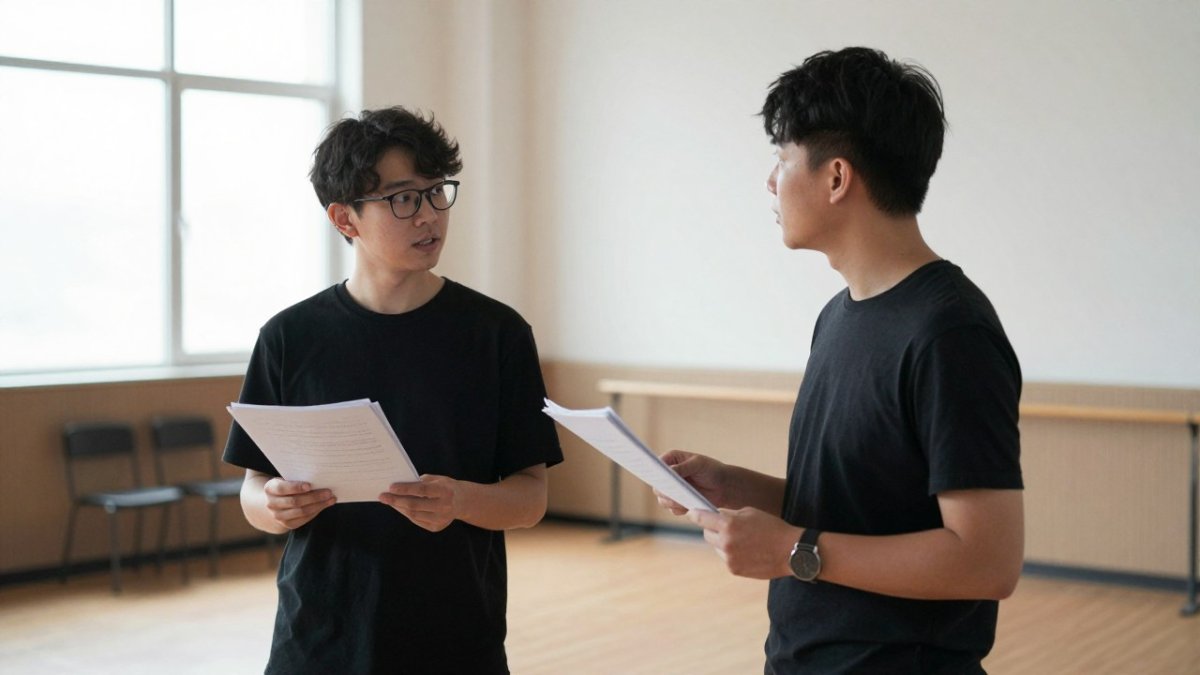
Useful exercises include:
- Objective swap: Play the same scene with the objective reversed. This exposes which choices are truly yours and which are habit.
- Silent beats: Run the scene with the lines reduced to a single word each, keeping the beats intact.
- Tempo shift: Repeat the scene at a faster and slower pace to test whether the emotional truth holds.
- Partner listening drill: Respond only to what your partner actually says, not to what you expect them to say.
These exercises target listening and specificity, two qualities that separate strong working actors from merely competent ones. Practice them with the same scene over several weeks to see measurable progress.
!Two actors rehearsing a scene across from each other in a bare studio rehearsal room, scripts in hand, natural window light
Choosing a Scene for Acting Class
The scene you bring to class shapes what you learn from it. The best choices are scenes with a clear emotional turn, a partner role with real stakes, and enough length to show change across several beats.
When choosing, consider:
- Clear stakes: Both characters should want something that the other can block or grant.
- Emotional range: A scene that moves between at least two distinct emotional states gives you more to work with.
- Your fit: Choose material that stretches you without asking you to play a role you cannot yet inhabit honestly.
- Length: Keep the scene short enough to rehearse thoroughly, usually a few pages at most.
Avoid scenes you have already performed many times. Familiarity tends to produce polished habits, not fresh discovery.
Advanced Scene Study Online Versus In Person
Advanced scene study runs in both formats, but the formats are not interchangeable for partner-based work. The trade-offs below are the ones that matter most for actors juggling auditions and bookings.
Partner work. In-person scene study lets you and a partner share a physical space, which makes reactions, timing, and spatial choices immediate.
Feedback. In person, an instructor can step in, adjust a partner’s position, and replay a beat on the spot. Online, feedback tends to arrive as verbal notes and self-review of recorded takes.
Scheduling. Online study removes commute time, which matters when an audition or a set call lands the same day as class. In-person study builds a fixed weekly anchor, which many working actors find easier to protect from schedule creep.
Networking. The professional value of a room is the people in it. In-person classes generate the hallway conversations, partner swaps, and casual referrals that lead to readings and recommendations.
Cost and total time. Compare total cost, not sticker price: add commute time, parking, and any equipment you need for a reliable online setup. Request current pricing directly from Ventura Actors Studio.
A workable pattern for many working actors is to use online sessions for text analysis, monologue coaching, and scene review between bookings, and to keep an in-person class for the partner-heavy scene work that benefits from a shared room. Ventura Actors Studio offers a June Zoom Class for remote instruction and its Zoom Lessons page explains how online sessions are structured, so you can judge the format against your own schedule before committing.
Watch out: an online class that never puts you and a partner in the same virtual room is not scene study, it is coaching. Confirm before you enroll that the format includes live partner work, not just solo monologue feedback.
Comparing Classes, Schedules, and Costs Before You Enroll
Most class pages describe one offering. Working actors need to compare several at once, because the wrong fit costs six weeks and a tuition payment you cannot get back.
1. Level and prerequisites. Ask what experience the class assumes.
2. Schedule and attendance policy. For working actors this is the deciding factor. Ask three questions: How many sessions can I miss before it affects the work?
3. Format and partner matching. Confirm whether partner work is live in every session, how partners are assigned, and whether you can request a partner at your level.
4. Class size. A room of eight to twelve actors gives each pair meaningful stage time. Larger rooms trade individual attention for volume.
5. Total cost, not sticker price. Add tuition, any materials or scene-rights fees, travel and parking for in-person sessions, and the cost of equipment for online work.
6. Instructor and teaching approach. Ask what the instructor’s professional background is, what technique the class draws on, and how feedback is delivered, publicly, privately, or in written notes.
7. Outcomes and expectations. Ask what a typical session looks like, how many scenes you will work over the term, and what progress is realistic.
Ventura Actors Studio currently offers several options to compare on these points: the New Friday 6 Week Class for a time-bound Friday commitment, the New Thursday 6 Week Class for a Thursday option, and the New Thursday Class Mixed Level for actors who want a mixed room. Tuition varies by class, dates, and format, so request current pricing and the missed-class policy directly from the studio and line the answers up against the seven points above.
Watch out: a class with no written attendance policy is a class where the policy will be decided case by case, usually not in your favor when a booking lands.
The table below sums up the key checks to run on each class option before you pay, drawn from the points covered in this section.
| Check | Why it matters | What to ask |
|---|---|---|
| Level and prerequisites | Mixed rooms need an instructor who differentiates | How are wide experience ranges handled? |
| Schedule and attendance | Bookings can clash with class | How many misses are allowed, and are make-ups offered? |
| Format and partner matching | Partner quality drives most of the learning | Is partner work live every session? Can you request a level? |
| Class size | Affects stage time per pair | How many scenes per session, and how much time each? |
| Total cost | Sticker price hides extra expenses | Are materials, travel or equipment extra? Payment plans? |
| Instructor and feedback | Feedback style must suit how you learn | What is the background and how is feedback given? |
| Outcomes and expectations | Promises of bookings are a red flag | How many scenes over the term, and what progress is realistic? |
Book Your Advanced Scene Study Consultation at Ventura Actors Studio
If you are a working actor ready to sharpen your scene work, Ventura Actors Studio can help you find the right advanced class. Its instructors bring over 40 years of experience across theater, television, film, and casting, and its alumni have booked roles on Grey’s Anatomy, Netflix films, and national commercials.
Book a consultation to talk through your goals, schedule, and current training, and to find the advanced scene study option that fits your next audition cycle.
Frequently Asked Questions
What is the difference between scene study and audition technique?
Scene study focuses on building a complete character through partner work, text analysis, and repeated rehearsal of longer scenes. Audition technique is narrower: it trains you to make strong choices in a few minutes, often with cold reads and self-tapes. Working actors usually need both. Scene study deepens your craft and gives you material to draw on, while audition technique teaches you to apply that craft under time pressure. A good advanced class will connect the two so the work you do on a scene carries over into the room.
How often should working actors take scene study classes?
Most working actors balance class around bookings, self-tapes, and day jobs, so consistency matters more than volume. A weekly or biweekly class with regular outside rehearsal is a common rhythm. Ongoing classes let you revisit scenes and track growth over months rather than cramming. Before enrolling, ask about session length, whether attendance is flexible when you have a shoot, and how much prep is expected between sessions so you can plan realistically.
Can working actors study scene work online?
Yes, many working actors study scene work online, especially when auditions and shoots are scheduled at short notice. Online classes work best when they include live partner work, not only lectures or recorded notes. Check whether the instructor gives individual feedback on your performance, whether you can record and review your work, and whether the format supports the scene partner exchanges that build listening and reaction. In-person training still offers stronger chemistry work, but online study can fill the gaps around a busy schedule.
How do I know if an advanced acting class will help me book roles?
No class guarantees bookings, so evaluate what you will practice and how. Look for instructors with current industry experience, clear teaching methods, and an emphasis on on-camera work and script analysis. Ask prospective studios what outcomes they track and what students typically work on by the end of a term. Treat the class as a way to build repeatable skills you can apply to every audition, rather than as a shortcut to callbacks. Pricing depends on class format, duration, and dates, so request current tuition and details directly from Ventura Actors Studio.


Related Posts
Best Acting Resume Fonts and Layouts That Book Roles
Your acting resume fonts and layout decide your first impression. Compare…

Is Professional Acting Training Worth the Cost?
Before you pay for acting training, total tuition, living costs, lost income…
Professional Acting Training for Kids: What Parents Should Check
Acting training for kids can build confidence, but program quality varies…