

Last Updated: October 28, 2026
Quick Summary
Professional acting coaching for adults focuses on the gap between stage habits and screen habits, such as adjusting volume, using smaller gestures, hitting marks, and reading scenes for what a lens catches. Adults can start without prior training, since mixed-level classes welcome beginners, and the best coaches give specific, on-camera feedback rather than general encouragement.
- Look for coaching that gives clear feedback on on-camera work, not just general encouragement.
- Community theater skills often need adjusting for film and TV, where the lens catches small movements.
- Beginners do not need prior training, and mixed-level classes let each student work at their own pace.
- Shoot self-tapes from mid-chest up, with the reader’s eyes placed at lens height.
- Ask a prospective coach what you will be able to do after the course that you cannot do now.
Table of Contents
- Why Adults Turn to Professional Acting Coaching
- Acting Classes for Beginners Adults Can Start Without Experience
- On-Camera Acting Classes for Adults: What Changes for Film and TV
- Adult Audition Preparation: Moving Past the Freeze
- Scene Study Classes for Adults and How They Build Range
- What to Look for in a Coach and How Credits Matter
- Comparing Costs, Formats and Time to Results
- Booking Your First Session at Ventura Actors Studio
- Frequently Asked Questions
Why Adults Turn to Professional Acting Coaching
Many adults who have spent years in community theater reach a point where they want more. They want on-camera work, auditions that lead somewhere, and a clear sense of whether their skills are ready for television or film. Professional acting coaching for adults can help students develop their skills.
Community theater builds confidence and stage craft. Film and television demand something different. The camera catches small movements, the lens sits a few feet away, and the scene can be cut down to a few seconds of usable footage. Many experienced stage actors find their first on-camera auditions humbling, even when their live performances are strong.
A good coach does not simply repeat what you already know. The most useful coaching focuses on the gap between stage habits and screen habits. That includes adjusting volume, using smaller gestures, hitting marks, and reading a scene for the reactions that matter most to a lens.
Here is what most adults want from coaching:
- Clear feedback on on-camera work rather than general encouragement
- Practice with scripts that resemble real industry material
- A realistic understanding of how casting and audition processes work
- A supportive room where mistakes are part of the process
Acting Classes for Beginners Adults Can Start Without Experience
Adults do not need prior training to begin. Our mixed-level classes welcome beginners.
Beginners often worry that they will look foolish in front of more experienced students. In a well-run mixed-level class, the exercises are designed so that everyone works at their own pace. A first-time student and a seasoned actor can both benefit from the same warm-up.
A common mistake is signing up for advanced workshops too early.
On-Camera Acting Classes for Adults: What Changes for Film and TV
On-camera work changes how you think about every line. You stop projecting to the back row and start focusing on the eyes of the person across from you. Small shifts in expression can carry an entire scene. Many students find this the hardest adjustment.
Film and television also require you to hit consistent marks, match energy from take to take, and deliver the same performance across multiple angles.
The industry also expects you to understand how a set operates.
What on-camera classes usually cover:
- Eyeline and framing for close-ups and medium shots
- Working with a scene partner who is off-camera
- Adjusting volume and movement for the lens
- Taking direction quickly and making adjustments on the next take
Adult Audition Preparation: Moving Past the Freeze
On the nerves side, the goal is not to eliminate adrenaline. Some energy helps a performance. The aim is to channel it into a clear first action. A practiced entrance, three slow exhales before you begin, and a single physical task for the first ten seconds of the scene do more than any mental pep talk.
Self-Tape Technical Requirements Most Actors Get Wrong
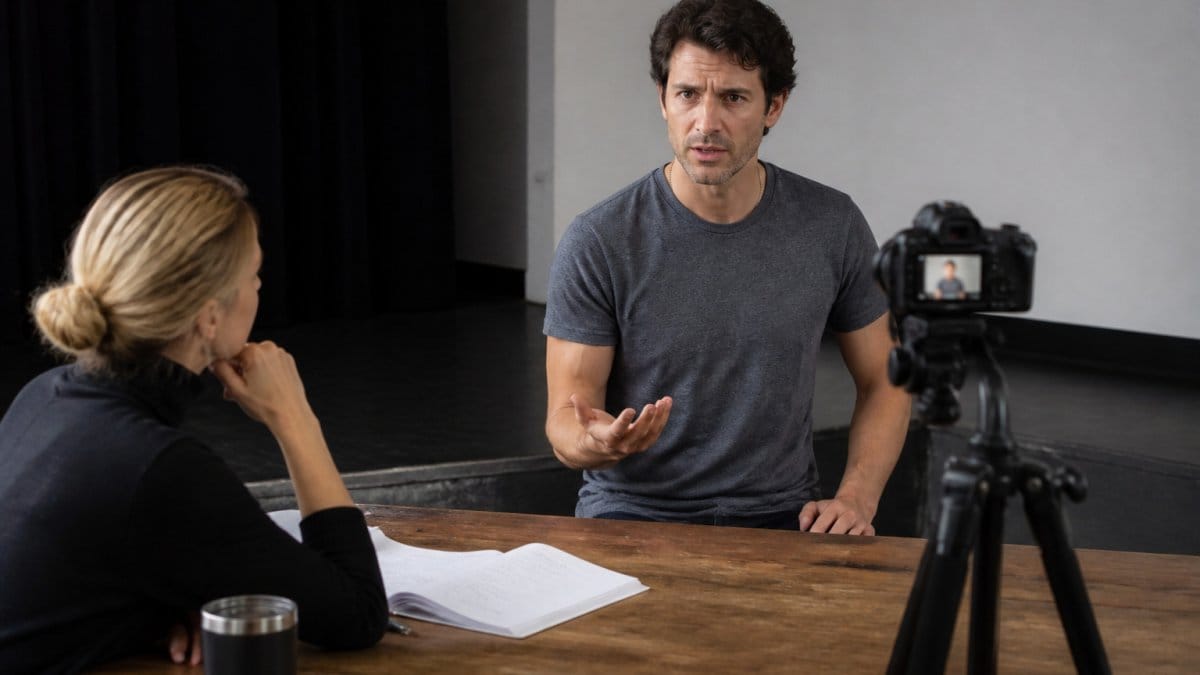
- Framing: Shoot from mid-chest up, with your eyes on the upper-third line of the frame. Leave a small amount of headroom. Do not crop the top of your head or center your eyes in the middle of the frame.
- Eyeline: Place the reader’s eyes at lens height, not below it. A reader seated at a laptop on a desk pulls your gaze down and makes you look distracted.
- Lighting: Put your key light in front of you and slightly off-axis, never behind. A window works if you face it. Avoid overhead-only light, which casts shadows under the eyes.
- Audio: Get the microphone as close as practical, a lavalier or a phone placed just off-frame beats a laptop mic across the room. Record a ten-second test and listen back with headphones before you commit.
- Background: A plain wall or a softly out-of-focus room. Nothing moving, nothing bright, nothing with text.
- Slate: State your name and, if requested, your location and representation. Keep it under ten seconds and deliver it in the same energy as the scene.
- File and naming: Follow the casting notice’s naming convention exactly. Reviewers sort hundreds of files, and a mislabeled tape can be skipped before it is watched.
Record a full take, then watch it back with the sound off. If the story of the scene does not read in your face and body alone, adjust before you record the version you submit.
Scene Study Classes for Adults and How They Build Range
Scene study can involve working with partners on scenes and analyzing the text.
Join our acting classes in Ventura today! →
Monologue work complements scene study.
A practical tip: record a rehearsal occasionally and watch it back.
What to Look for in a Coach and How Credits Matter
When you choose a coach, look at teaching experience and professional work. Credits matter because they show the instructor understands current industry standards. Ask about the coach’s background in theater, television, film, or casting, and ask how long they have been teaching. Our instructors bring more than 40 years of combined experience across theater, television, film, and casting. Gina Nemo, founder of Ventura Actors Studio, is an award-winning actress and producer, and she studied with Peggy Feury at the Hollywood Loft Studio. Our alumni have booked roles on Grey’s Anatomy, Netflix films, and national commercials.
Credits are only one signal. Class size, feedback style, and whether the coach will challenge you matter just as much. Small classes give students personal attention.
A Decision Framework by Career Stage
Beginners and working professionals need different things from a coach, and the same program rarely serves both well. Use this matrix to narrow your search before you inquire:
| Your stage | What you need most | What to ask a coach | Red flags |
|---|---|---|---|
| Curious beginner (no credits, some community theater) | Comfort with basic tools, low-pressure repetition, a clear on-ramp | How many students per class? Is there a beginner-friendly track? How much time is spent on camera versus discussion? | Advanced-only workshops, large lecture-style classes, no recorded feedback |
| Returning adult (trained years ago, out of practice) | A realistic read on current industry standards and a refresher on self-tapes | Can we do a diagnostic session first? How do you assess where I am now? | Programs that assume you are starting from zero or assume you are already working |
| Working or semi-pro actor (some credits, auditioning regularly) | Targeted audition coaching, callback adjustments, career guidance | Do you coach specific auditions? Can you review self-tapes between sessions? | Generic scene-study-only programs with no audition component |
| Career-changer (strong in another field, new to acting) | Honest assessment of readiness and a realistic timeline | What does progress look like in six months? What do you expect me to do between sessions? | Promises of representation or bookings, guaranteed outcomes |
The single most useful question to ask any coach is: “What will I be able to do after this course that I cannot do now?” A coach who answers with specific skills and a way to measure them is usually a better fit than one who answers with credentials alone.
A few practical checks before you commit. Ask about the class format and how students receive feedback.
Comparing Costs, Formats and Time to Results
For current pricing, visit the Ventura Actors Studio website or contact the studio for a quote.
Time to results depends on your goals.
Comparing programs side by side can help. Consider class size and whether a program fits your schedule.
Booking Your First Session at Ventura Actors Studio
Bring questions about your goals, such as whether you want to focus on television, film, commercials, or audition preparation.
Join our acting classes in Ventura today and take the next step toward the work you want to do.
Frequently Asked Questions
What should adults look for in a professional acting coach?
Ask whether classes are mixed-level and about class size. Ventura Actors Studio offers small classes and mixed-level classes that welcome beginners. For current pricing, visit the studio’s website or contact the studio for a quote.
Can adults with no experience take acting classes?
Yes. Ventura Actors Studio offers mixed-level classes that welcome beginners.
How can acting coaching help with auditions?
Adult audition preparation focuses on script analysis, cold reading, making strong choices quickly and managing nerves in the room. Practicing under realistic conditions, including self-tapes framed and lit the way casting directors expect, helps reduce the freeze many actors experience. Coaches can give specific feedback on your choices so you learn what works in front of a camera, not just in a rehearsal space.
How long before adults see results from acting classes?
Results vary by goals, starting point and how often you train. Most students notice improved comfort in class within the first several weeks, while audition callbacks depend on the market, your type and the material you are submitting for. Ask Ventura Actors Studio for a realistic timeline based on your goals, and avoid committing to long programs before you have tried a short course and assessed your progress.


Related Posts
Best Acting Resume Fonts and Layouts That Book Roles
Your acting resume fonts and layout decide your first impression. Compare…

Is Professional Acting Training Worth the Cost?
Before you pay for acting training, total tuition, living costs, lost income…
Professional Acting Training for Kids: What Parents Should Check
Acting training for kids can build confidence, but program quality varies…