

Last Updated: November 5, 2026
Quick Summary
The best on-camera acting techniques for beginners start with doing less: the camera magnifies everything, so keep gestures and expressions smaller than stage work. Build comfort through daily recording, real listening, and matching your performance to the shot size. Practice stillness, eyeline control, and deliberate pauses in short, frequent sessions.
- Record yourself for five minutes a day, watch the playback once, then delete it.
- In a close-up, use subtle expressions and minimal movement; in a medium shot, normal gestures work.
- Run the four-week exercise plan three sessions a week, twenty to thirty minutes each.
- On camera, play the scene at the volume you would use talking across a small table.
- Hitting your marks matters most in close-ups and in any shot where the camera moves.
Table of Contents
- How to Get Comfortable in Front of a Camera
- How to Act Naturally on Camera
- Camera Shots Every Actor Should Know
- On-Camera Acting Exercises to Build Your Skills
- Self-Tape Setup and Practice Routine for Beginners
- Stage Acting vs. Screen Acting: Key Differences
- Next Steps: Building Your On-Camera Skills at Ventura Actors Studio
- Frequently Asked Questions
How to Get Comfortable in Front of a Camera
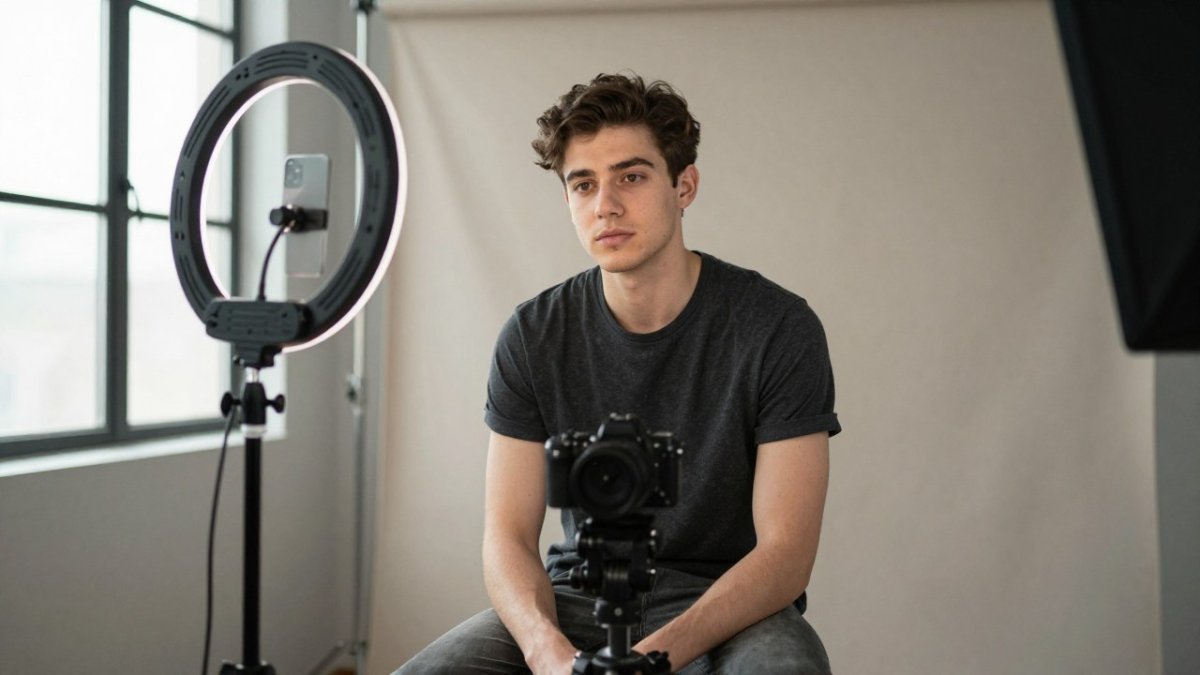
Most beginner actors freeze the moment a lens points at them. The fix isn’t confidence, it’s exposure. At Ventura Actors Studio, we teach students that comfort on camera is a skill you build, not a personality trait you’re born with. Getting reps in front of a rolling camera, even a phone camera, is a common starting point until the lens stops feeling like a threat.
Here’s what actually helps:
- Record yourself for five minutes a day, even just reading a script
- Watch the playback once, then delete it, so perfectionism doesn’t creep in
- Practice with a tripod so the camera becomes a fixed, familiar object
- Breathe low and slow before each take to calm nerves
Nerves don’t disappear, they settle. Give yourself a few weeks of daily recording and many actors find the camera starts to feel like a scene partner instead of a judge.
How to Act Naturally on Camera
Natural on-camera acting comes from doing less, not more. The camera magnifies everything, so the performance that reads as believable on screen is typically smaller than what works on stage. Beginners tend to push, and the lens punishes it.
Three habits separate natural from stiff:
- Think, don’t show. Let a thought sit behind your eyes instead of announcing it with your face.
- Listen for real. React to your scene partner’s words as if hearing them the first time.
- Let silence work. Pauses and stillness read as truthful on camera, not as mistakes.
The biggest beginner mistake is acting the emotion instead of playing the objective. Pick a clear goal for your character, then let the emotion arrive on its own. That’s how you learn how to act naturally on camera without forcing anything.
Camera Shots Every Actor Should Know
Knowing the shot size changes how you perform. If you don’t know where the frame cuts, you’ll over-gesture in a close-up or underplay a wide shot. Here are the core camera shots every actor should know:
| Shot | What It Shows | How to Adjust |
|---|---|---|
| Establishing shot | Wide setting and location | Full body, larger movement is fine |
| Medium shot | Waist up | Normal gestures, natural posture |
| Close-up | Face and shoulders | Subtle expressions, minimal movement |
| Extreme close-up | Eyes and small details | Stillness, tiny reactions only |
Camera awareness means respecting the edge of frame. In a close-up, a big hand gesture disappears off screen or looks enormous. In a medium shot, you have room to move. Ask your director or reader which shot is being framed before the take, and match your performance to it.
On-Camera Acting Exercises to Build Your Skills
The right on-camera acting exercises train subtlety, listening, and camera awareness all at once. What separates a useful drill from a vague suggestion is that you can run it the same way every time, measure something concrete, and know when to move on. Short, repeated sessions are generally more effective than one long weekly session, because the camera habit is built through frequency, not duration.
Run this four-week progression, three sessions a week, twenty to thirty minutes each. Record every session on your phone, locked off on a tripod at eye level, and keep the files so you can compare week one to week four.
Week 1, Stillness and the close-up. Record a 60- to 90-second monologue framed chest-up. Your only goal is to stay still from the collarbone down and let your eyes and face carry the story. Watch the playback with the sound off first: if your hands, shoulders, or head are moving without purpose, that is the habit to name.
Week 2, The listening drill. Have a partner (or a recorded reader) deliver lines while you react without speaking. The trap here is fake listening, nodding on cue, widening your eyes at every beat. Watch the playback and mark every reaction that arrived before you actually processed the line.
Week 3, The eyeline exercise. Practice holding focus just off the lens so you look like you are talking to a real person, not a camera. Set a small mark, a sticker or a piece of tape, just beside the lens at your eye height, and keep your gaze there through the whole take.
Week 4, The pause test. Perform a scene and deliberately leave three beats of silence at chosen moments, then check whether the silence feels alive or dead. A pause reads as truthful when something is happening behind your eyes; it reads as a stall when you are simply waiting for your next line. Record the same scene twice, once rushing through the pauses and once holding them, and watch both back-to-back.
How to assess progress without becoming self-conscious. After each session, write down one thing that worked and one fix for next time, no more. At the end of four weeks, watch your week-one and week-four tapes side by side and score each on four things: distracting movement, vocal clarity, eye focus, and whether the reactions felt real.
Watch out: reviewing every take frame by frame turns practice into self-auditioning and can make camera awareness worse, so limit playback to one pass and one written note per session.
Join our acting classes in Ventura today! →
If you want a full set of solo drills, our guide on how to practice acting at home alone walks through a complete beginner routine you can run without a partner.
Self-Tape Setup and Practice Routine for Beginners
A clean self-tape needs very little gear. Beginners overthink the technical side and underthink the acting. Here’s a simple setup that works:
- Camera: Your phone, locked off on a tripod at eye level
- Light: One soft light or a window in front of you, never behind
- Sound: A quiet room and a mic close to you if you have one
- Background: A plain wall, free of clutter
- Framing: Chest-up, with your eyeline just beside the lens
Run a weekly practice routine: pick a short scene, set up your tape, record three takes, then watch the playback and note one fix. Playback is your best coach. You’ll spot fake reactions, wandering eyes, and gestures that read too big. Fix one thing per week and your tapes improve fast.
Stage Acting vs. Screen Acting: Key Differences
Screen acting rewards restraint while stage acting rewards reach. On stage, you project to the back row and repeat the same performance eight times a week. On camera, the lens is inches away and catches everything, and you may perform the same beat a dozen times out of order. A stage-trained actor’s biggest adjustment is scaling down: smaller gestures, quieter voice, and trust that the camera will see a subtle choice.
Scale and vocal delivery. Stage voice is built to fill a room without amplification; screen voice is conversational, often quieter than you think. A useful calibration: on camera, play the scene at the volume you would use talking to someone across a small table. If a director asks for more energy, give more intention rather than more volume.
Marks and continuity. In film and television, your position in the frame is part of the performance. You will be given marks, tape or markers on the floor, and asked to hit them so the camera can keep you in focus and in frame. Hitting a mark matters most in close-ups and in any shot where the camera is moving.
Eyelines across angles. Each camera angle has its own eyeline. In a two-person scene, you may play to a reader standing beside the lens for your coverage, then to the other side for your partner’s coverage. Ask which eyeline applies before each setup, and keep your focus consistent so the editor can cut between angles without your gaze jumping. The eyeline exercise in the previous section is the drill that builds this habit.
Repetition and stamina. Stage work runs start to finish; film work is fragmented. You may do the same 30-second beat fifteen times, then wait an hour, then do it again from a different angle. The skill is staying fresh and specific on take twelve, not just take one.
Adjusting to shot size. A performance that works in a wide shot can look enormous in a close-up. Before each take, confirm the framing and match your movement to it: full-body freedom in a wide, minimal gesture in a close-up. This is the same principle covered in the camera shots section, applied on set.
If you are moving from theater to film, our guide on how to transition from stage to screen acting breaks down the specific habits to unlearn. The good news: stage training gives you strong instincts for objective and listening. You are refining, not starting over.
Next Steps: Building Your On-Camera Skills at Ventura Actors Studio
Reading about technique only takes you so far. The real growth happens when a trained eye watches your work and tells you exactly what to adjust. That’s where we come in.
At Ventura Actors Studio, our classes are built for beginners and seasoned actors alike. We keep class sizes small so every student gets personal attention. Our instructors bring over 40 years of experience across theater, television, film, and casting, and our founder, award-winning actress and producer Gina Nemo, studied with Peggy Feury at the Hollywood Loft Studio. Our alumni have booked major roles on Grey’s Anatomy, Netflix films, and national commercials.
If you’re weighing your options, our guide on how to choose on-camera acting coaching covers what to look for. Ready to jump in? Our class welcomes beginners, and you can contact us with any questions before you enroll. Get started with Ventura Actors Studio and turn camera nerves into camera confidence.
Frequently Asked Questions
What are some effective techniques for acting on camera?
Effective on-camera acting techniques focus on subtlety and truth. Keep movements small, use your eyes and facial expressions to convey emotion, and listen genuinely to your scene partner. Practice with self-tapes to see how you look on screen, and learn basic camera shots so you understand framing. Exercises like the object exercise and repetition help build natural behavior. Consistency in practice is key.
How can beginners look natural on camera?
To look natural on camera, relax your body and avoid over-gesturing. Speak in a conversational tone and let your reactions come from listening. Practice with a camera to get used to seeing yourself, and focus on your scene partner rather than the lens. Techniques like the ‘as-if’ exercise and sensory work help create believable behavior. Small, specific actions read better on screen than large theatrical ones.
What is the difference between stage acting and screen acting?
Stage acting requires projecting to the back of the house with big gestures and a loud voice, while screen acting demands subtlety because the camera captures micro-expressions. On camera, you perform for a close-up, so small movements and eye focus are crucial. The rehearsal process also differs: stage actors have weeks of rehearsal, while screen actors often work quickly with less preparation. Adjusting to these differences is essential for beginners.
How can I stop feeling awkward in front of a camera?
Feeling awkward is common for beginners. Start by practicing alone with a camera, recording short monologues or simple actions. Review the footage to desensitize yourself to seeing your image. Focus on the task (like listening or pursuing an objective) rather than self-consciousness. Exercises like the ‘private moment’ and physical warm-ups help release tension. Over time, regular practice builds comfort and confidence.
The gap between actors who book work and those who don’t often comes down to who trained for the lens, not just the stage. Our small classes and working-professional instructors give you the real tools to walk into any audition prepared. Get started with Ventura Actors Studio and build the on-camera skills that get you callbacks.


Related Posts
Best Acting Resume Fonts and Layouts That Book Roles
Your acting resume fonts and layout decide your first impression. Compare…


Is Professional Acting Training Worth the Cost?
Before you pay for acting training, total tuition, living costs, lost income…
Professional Acting Training for Kids: What Parents Should Check
Acting training for kids can build confidence, but program quality varies…