

Table of Contents
- Understanding Audition Anxiety and Nerves
- Preparing Mentally Before an Audition
- Breathing Exercises for Performance Anxiety
- How to Memorize Audition Sides and Build Confidence
- Your Audition Preparation Checklist: The Day Before and Day Of
- What to Do If You Mess Up an Audition
- Managing Physical Symptoms and Staying Present
- Building Long-Term Confidence Through Repeated Exposure
- Frequently Asked Questions
Last Updated: October 11, 2026
Understanding Audition Anxiety and Nerves
Audition anxiety is the nervous tension and self-doubt that performers experience before and during an audition. It’s that tightness in your chest, the racing thoughts, the shaky hands. For many actors, audition anxiety feels like the biggest barrier between them and booking roles.
Here’s what matters: this feeling is completely normal. Even working actors still get nervous. The difference between those who book roles and those who don’t isn’t the absence of anxiety, it’s how they manage it.
At Ventura Actors Studio, we work with actors at every level, from beginners to seasoned professionals. We’ve seen firsthand that audition nerves don’t have to derail your performance. They’re actually a sign you care about doing well. The key is channeling that energy into focus instead of letting it scatter your attention.
Audition anxiety shows up differently for different performers. Some actors freeze and forget their lines. Others rush through their material. Some experience physical symptoms like shaking, nausea, or a racing heart. Understanding which version you experience is the first step toward managing it.
The worst thing you can do is pretend the nerves aren’t there. Acknowledge them. Name them. Then move forward anyway. Actors who fight their anxiety waste energy that could go into their performance.
Preparing Mentally Before an Audition
Mental preparation starts days before you walk into the audition room, not the morning of. Your mind needs time to build confidence and process the material.
Begin by understanding the character and the scene deeply. Read the entire script if you can get it. Know who your character is, what they want, and why they want it. This knowledge becomes your anchor when nerves try to pull you away from the moment.
Visualization is one of the most powerful mental tools available. Spend 5-10 minutes each day imagining yourself in the audition room. See yourself walking in calmly. Picture the casting director’s face. Hear yourself delivering your lines with confidence and presence.
Self-talk matters more than most actors realize. Notice the voice in your head that says things like “I’m going to mess this up” or “Everyone else is better than me.” That’s your inner critic. When you hear it, replace it with something grounded: “I’ve prepared well. I know my material.
The night before your audition, get solid sleep. Avoid cramming or over-rehearsing. Your preparation is done. Rest lets your nervous system reset and your mind consolidate what you’ve learned.
Mental preparation isn’t about eliminating nerves. It’s about building a foundation of confidence that stands firm when anxiety shows up.
Breathing Exercises for Performance Anxiety
Your breath is the fastest way to calm your nervous system. When anxiety spikes, your breathing becomes shallow and rapid. Controlling your breath reverses that pattern and signals to your body that you’re safe.
The 4-4-4 breathing technique works quickly and can be done anywhere. Breathe in through your nose for a count of four. Hold for four counts. Exhale through your mouth for four counts. Repeat this cycle five to ten times.
Box breathing is another reliable method. Inhale for four counts, hold for four, exhale for four, hold for four. The equal counts create a rhythm that settles racing thoughts.
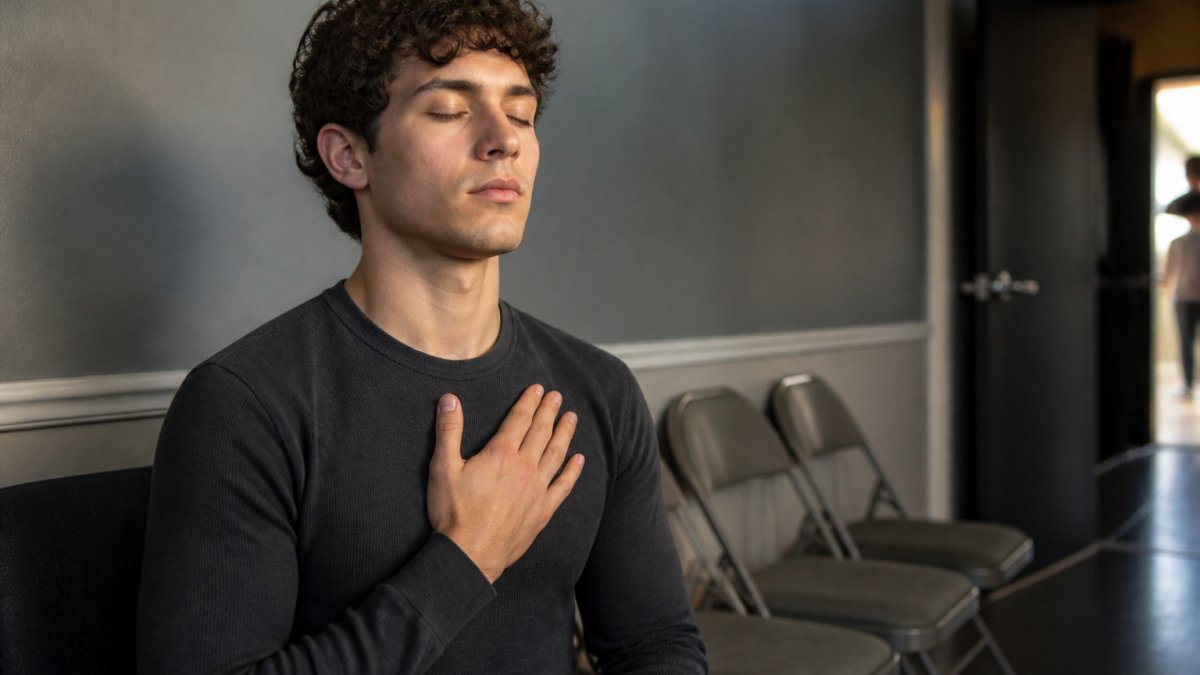
Diaphragmatic breathing is the foundation of both techniques. Place one hand on your chest and one on your belly. When you breathe, your belly should expand, not just your chest.
Practice these techniques when you’re calm, not just when you’re anxious. Your nervous system learns patterns. If you only breathe deeply when you’re panicking, it’s harder to access that skill under pressure. Practice daily, even for just two minutes.
How to Memorize Audition Sides and Build Confidence
Memorizing your audition sides thoroughly removes one major source of anxiety. When you know your lines cold, you have mental space to focus on your performance instead of scrambling to remember words.
Start by reading the sides multiple times without trying to memorize. Understand the story, the character’s emotional arc, and how your character relates to others in the scene.
Say your lines out loud. Reading silently doesn’t create the same neural pathways as speaking. Your brain needs to hear your own voice saying the words. Practice in different ways: standing, sitting, with different emotional intentions.
Here’s a common mistake: memorizing the words but not the emotions. You need both. Know not just what your character says, but why they say it. What do they want in this moment? How do they feel?
Record yourself and listen back. Hearing your own performance reveals patterns you can’t see from the inside. You might notice you’re rushing certain lines or losing emotional clarity in specific moments. Adjust and record again.
Confidence builds through preparation. The more thoroughly you know your material, the more trust you have in yourself. That trust becomes visible in the audition room. Casting directors feel it.
Your Audition Preparation Checklist: The Day Before and Day Of
Preparation the day before your audition sets the tone for how you’ll feel and perform.
Day Before Checklist:
- Review your sides one final time, but don’t over-rehearse
- Get all your logistics handled (know the address, parking, arrival time)
- Lay out your clothes and headshots
- Eat a balanced meal with protein and complex carbs
- Avoid alcohol and excessive caffeine
- Get to bed on time for solid sleep
- Do a brief visualization session before sleep
Day Of Checklist:
Join our acting classes in Ventura today! →
- Eat a light breakfast with protein (eggs, yogurt, or nuts work well)
- Avoid sugar and caffeine on an empty stomach, they spike anxiety
- Warm up your voice and body gently
- Review your sides one time only
- Arrive 10-15 minutes early, not an hour early
- Use breathing exercises while you wait
- Put your phone away once you arrive
- Use the waiting room to observe other actors, not to compare yourself to them
| Timing | Action | Purpose |
|---|---|---|
| Night before | Light review + visualization | Settle your mind |
| Morning | Balanced breakfast + gentle warm-up | Stable energy |
| 30 min before | Breathing exercise | Calm nervous system |
| In waiting room | Phone away, observe others | Stay present |
| Right before | Final deep breath | Ground yourself |
Arriving too early amplifies anxiety. You sit in the waiting room watching other actors, your mind spins, and your nerves escalate. Arrive just early enough to check in and settle yourself.
What to Do If You Mess Up an Audition
Every actor has flubbed lines, forgotten words, or felt their performance fall apart mid-audition. It happens. The difference between booking and not booking often comes down to what you do in that moment.
If you mess up, pause for a breath. Don’t panic or apologize profusely. Many casting directors expect actors to recover gracefully. Show them you can handle pressure. Take a beat, reset your focus, and start the line again. Most casting directors will let you continue.
If you completely lose it, your mind goes blank, your voice cracks, you can’t recover, stay professional. Acknowledge it calmly: “Can I start that again?” Most casting directors will say yes. If they don’t, thank them, leave with your head up, and move on.
Here’s the truth: one mistake rarely costs you the role. Casting directors know acting is hard. They’re looking for actors who can stay present and professional even when things go wrong. Your recovery is often more impressive than a perfect take would have been.
After the audition, don’t ruminate. You did your best with the preparation you had. Dwelling on what went wrong only feeds anxiety for your next audition. Acknowledge what happened, extract any useful lesson, then let it go.
Managing Physical Symptoms and Staying Present
Physical symptoms of audition anxiety, shaking, nausea, a racing heart, dry mouth, feel terrifying in the moment. But they’re just your body’s stress response. They’re not dangerous, and they don’t mean you can’t perform.
Shaking often comes from adrenaline and shallow breathing. Ground yourself by pressing your feet firmly into the floor. Feel the solid ground beneath you. This simple action signals safety to your nervous system.
Nausea and a racing heart respond well to the breathing techniques covered earlier. Slow, deep breathing tells your body the threat has passed. Your heart rate will normalize. Your stomach will settle.
Dry mouth is common and manageable. Take small sips of water before you go in. Once you start speaking your lines, your mouth usually produces saliva naturally. If it doesn’t, it’s not a major issue, casting directors understand.
Staying present means focusing on what’s happening right now, not worrying about what might happen. When anxiety pulls your attention to the future (“What if I mess up?”), gently bring it back to the present moment. Feel your feet on the ground.
One practical technique: before you start your audition, take three seconds to really look at the casting director or reader. Make eye contact.
Actors who tend toward physical anxiety symptoms benefit most from grounding techniques and breathing work. These methods work quickly and can be deployed anywhere.
Building Long-Term Confidence Through Repeated Exposure
The most effective way to overcome audition anxiety long-term is to audition repeatedly. Exposure works. Each audition you do makes the next one feel less terrifying.
Your first few auditions will feel high-stakes and scary. That’s normal. By your tenth or twentieth audition, the novelty wears off.
This is why consistent training matters. At Ventura Actors Studio, students who attend classes regularly and participate in scene work build confidence faster than those who train sporadically.
Start with lower-stakes auditions if you can. Community theater, student films, local commercials. These auditions have less pressure, so you can practice your audition skills without your nervous system going into overdrive.
Keep a record of your auditions. Write down what you did, how you felt, and what you learned. Over months, you’ll see patterns. You’ll notice which preparation methods work best for you.
The goal isn’t to eliminate audition anxiety. The goal is to build enough experience and skill that anxiety becomes background noise instead of the main event. You’ll still feel it.
Audition anxiety is real, but it’s also manageable. The strategies in this guide, breathing techniques, mental preparation, thorough memorization, and repeated exposure, work because they address anxiety from multiple angles.
At Ventura Actors Studio, we teach these exact methods to our students. Our instructors, with over 40 years of experience, have guided actors through audition anxiety. When you’re ready to work with professionals who understand what you’re going through and have proven techniques to help, join our acting classes in Ventura today.
Frequently Asked Questions
How do I calm my nerves right before walking into the audition room?
Use the 4-7-8 breathing technique: inhale for 4 counts, hold for 7, exhale for 8. This activates your parasympathetic nervous system and lowers your heart rate. Practice this 3-5 times in the waiting room. Pair it with positive self-talk: remind yourself that you’ve prepared and you belong in that room. Physical grounding also helps, press your feet firmly into the floor and notice five things you can see to anchor yourself in the present moment.
Why do I freeze or blank during auditions when I know my lines at home?
Audition anxiety triggers your fight-or-flight response, which diverts blood from your prefrontal cortex (where memory lives) to your muscles. This is a physiological response, not a character flaw. Combat it through repeated exposure to audition-like conditions: film yourself, perform in front of friends, attend open casting calls, and practice under time pressure. The more you simulate the audition environment, the more your nervous system recognizes it as safe and your memory stays accessible.
What should I do if I mess up during an audition?
Stay in character and keep going. Casting directors expect mistakes, they’re human too. Acknowledge it silently and move forward without apologizing or breaking character. If you completely lose your place, pause briefly, take a breath, and ask the casting director if you can start that section again. Most will allow it. After the audition, resist the urge to replay the mistake obsessively. Write down what happened, identify one thing to improve for next time, then let it go. One mistake rarely costs you the role.
How long does it take to overcome audition anxiety with consistent practice?
Most actors notice measurable improvement in 4-8 weeks of consistent audition exposure and anxiety management practice. However, some nervousness is normal and even useful, it shows you care about the role. The goal isn’t to eliminate anxiety entirely, but to manage it so it doesn’t sabotage your performance. Attend auditions regularly, use the techniques in this guide, and track your progress. With time and repetition, your nervous system adapts and your confidence builds naturally.
Related Posts

Best Acting Resume Fonts and Layouts That Book Roles
Your acting resume fonts and layout decide your first impression. Compare…


Is Professional Acting Training Worth the Cost?
Before you pay for acting training, total tuition, living costs, lost income…

Professional Acting Training for Kids: What Parents Should Check
Acting training for kids can build confidence, but program quality varies…